
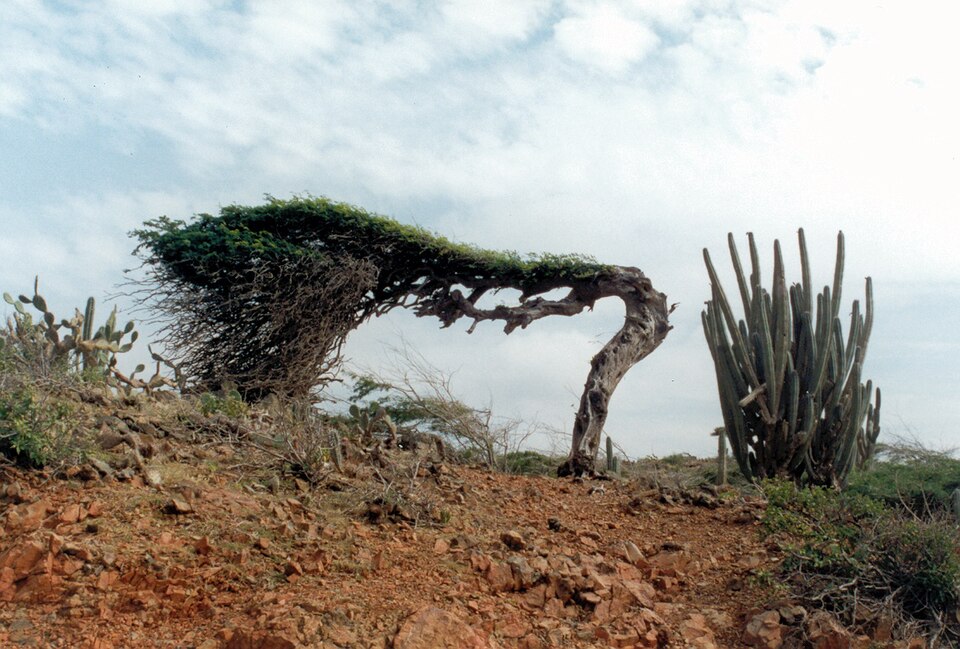




(Oranjestad)— Standing proudly and always pointing west, the Watapana (also called Divi Divi—though some say erroneously so) played an important role in one of the island’s first industries. Since then, it has been recognized as Aruba’s national tree. Here are some facts about the sturdy Watapana.
The Watapana name comes from the indigenous word “Guatapana” and is a symbol of hope and resilience. The Watapana grows in the direction of the wind; that’s why you will always see a Watapana pointing west.
The name ‘Divi Divi’ originated in Curacao during the 17th century when Watapana beans were exported from the Antilles to Europe to produce dye. The fruit of the Watapana contains tannin, a chemical compound that naturally produces a dye that was used for tanning leather back then.
In Aruba, the tannin industry gave manylocals temporary work. Watapana beans were collected and taken to the cunucu* owner in exchange for 25 cents for every 20 kilos. After collecting the beans, workers would have to pick out the best ones for exportation: Deep red pods were preferred; green or black pods were considered premature or damaged. The end of the tannin industry in Aruba faded out with the introduction of synthetic dyes. This proved to be a much cheaper option than processing tannin.
In 1979, the Watapana was inaugurated as Aruba’s national tree.
*Cunucu: Land used for food cultivation and herd farming.
Source: Chabalito magazine – E Watapana (2010)