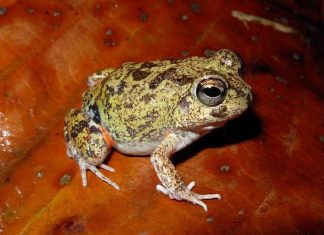

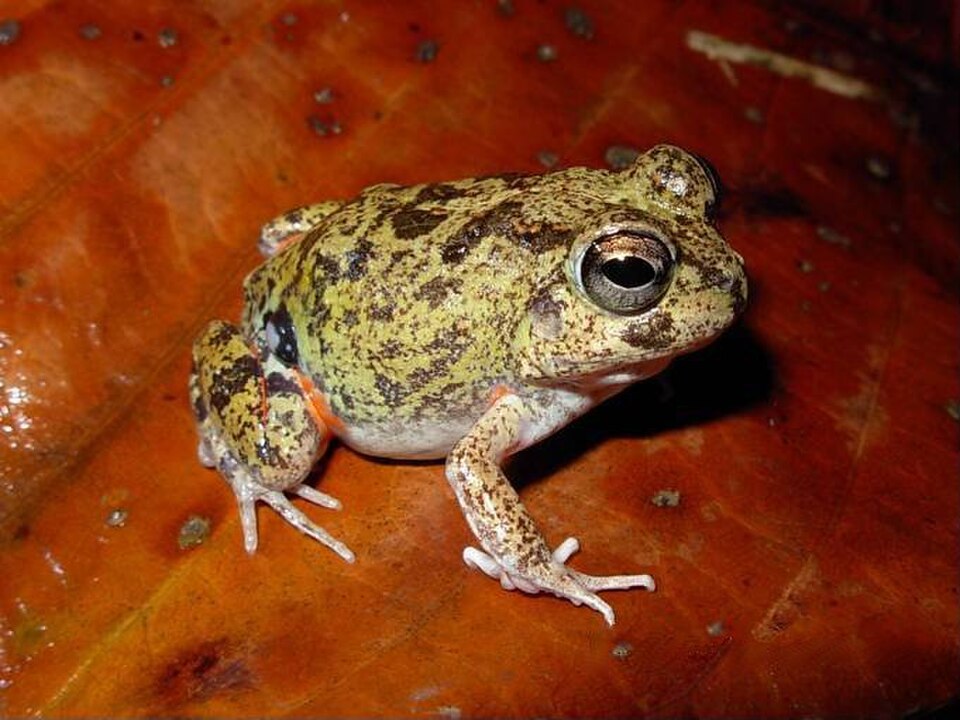




(Oranjestad)—Aruba has a very diverse fauna. Many know the burrowing owl ‘Shoco’ or the native rattlesnake ‘Cascabel’, but did you know that Aruba is also home to a small frog specie we call Dori? Rarely spotted around the island, this little frog is recognizable by two inguinal poison glands on its rear that resemble eyes. The Dori is also known as the Colombian four-eyed frog.
Scientifically classified as Pleurodema brachyops, the Dori is a protected animal on Aruba and can also be found in Brazil, Colombia, Guyana, Panama and Venezuela. Though ephemeral or permanent pools are essential for breeding, you can encounter a Dori far from a fresh water source. However, fresh water continues to be important for their survival, so you won’t see much of them during Aruba’s dry seasons.
The Dori was at one point the only amphibian on the island, until the invasive Sapo (marine toad) was introduced around 1960. According to some sources, these species can be accidentally introduced through importation of soil or pre-planted trees.
The Dori population on Aruba is dwindling, so it’s highly important to conserve their existence by protecting their habitats (like wetlands).
A recognizable feature of the Dori is its poison glands on its rear. When threatened, Dori lowers its head and raises its rear end. The poison glands of it rise back towards the predator. The glands can look like a set of eyes, causing the predator to confuse the Dori as a larger animal.
If this doesn’t work, Dori straightens out its back legs to reveal the vibrant orange coloration in an attempt to startle the predator. If the hungry creature decides to take a bite out of the frog, it ends up with a mouthful of poison.
Before the current banknotes of the Aruban florin were introduced in 2019, the Dori was featured on the 100 florin banknotes from 1990 to 2019.
Sources: Etnia Nativa and Ms. Yesenia Arends on Facebook.
Photo credit: Mauricio Rivera Correa