



In this new episode Etnia Nativa shares the resilient legacy of Oranjestad’s oldest Catholic landmark: San Francisco Church.
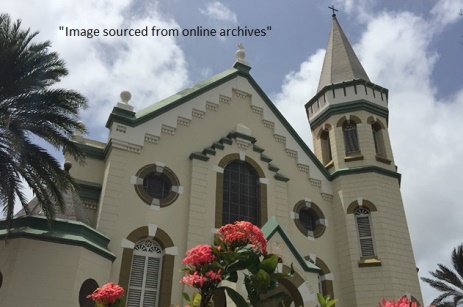
In the heart of Oranjestad—where pastel facades meet the Caribbean sun—stands a monument not only of faith, but of endurance. The Pro-Cathedral of Saint Francis of Assisi, often simply called San Francisco Church, carries within its walls a story shaped by devotion, disaster, and determination.
Each week, Etnia Nativa unveils a new chapter of Aruba’s cultural memory. This episode turns back the clock to April 1863, when a Capuchin priest—J.A. te Riele—laid the foundation for what would become one of the island’s most iconic spiritual sites. Known locally as “Father Terrible,” not for his temperament but for the Papiamento twist of his name, he envisioned a cruciform church complete with altar and sacristy.
Etnia Nativa: Your peek into Native magic, healing the spirit.
Article by Etnia Nativa call us 592 2702 and book your experience!
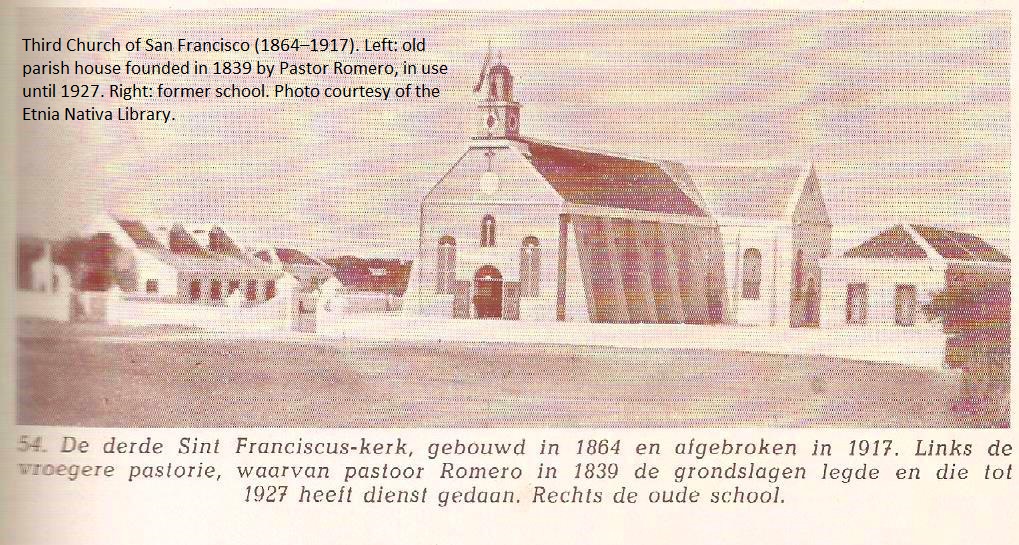
The initial stone was ceremonially placed by van den Bossche, using salvaged stones from a nearby plantation wall—an early symbol of renewal and resourcefulness. The first church in Oranjestad was built using local adobe techniques, or torto, and was covered with a roof made of earth, maize stalks, and cactus wood. This modest church was destroyed during a heavy rainstorm in 1813. However, the true builders were the people: parishioners who gathered in unity, carrying stones by hand, transforming their faith into physical devotion.
Yet, what was meant to be a day of triumph became a test of resilience. On the planned consecration day—Feast of Saint Francis of Assisi—a violent storm swept through Oranjestad. Torrential rains and fierce winds caused one of the church’s stone walls to collapse. The rushed construction, likely using still-damp manposterie (coral stone masonry), could not withstand the weight of its own ambition.
What remained standing—the north wall, a modest tower, and the sanctuary—became symbols not of failure, but of persistence. Within months, the church rose again. For the people of Aruba, building a church was never just construction; it was conviction.
As Father Terrible departed to the Netherlands for medical care, the island faced a shortage of clergy. Churches in Noord, Santa Cruz, and Oranjestad were left to share limited pastoral support. This vacuum eventually welcomed the Dominican order in 1886, who would later preside over the church’s solemn consecration.
Driven by missionary zeal, Father Terrible sought to extend his work to the Paraguaná Peninsula, where cultural and linguistic ties with Aruba ran deep—echoes of a time when both regions were connected under the Caquetio people. Though his mission was short-lived due to ecclesiastical disapproval, it reflected a broader vision of unity across shores.
The original structure, however, would not stand forever. In 1917, it was demolished, making way for a new chapter. By 1919, the church was reborn—this time under the design of Sephanus van de Pavert, echoing the architectural spirit seen in the Church of Santa Anna.
Meanwhile, Oranjestad itself was evolving. Protestant and Jewish merchant families, many from Curaçao, were establishing roots, eventually building their own houses of worship. A quiet religious diversity began to shape the city’s identity.
Today, the Pro-Cathedral stands not just as a place of prayer, but as a living chronicle. Its stones whisper stories of storms weathered and communities united.
For those eager to go beyond the surface of Aruba’s postcard beauty, Etnia Nativa offers something rare: a deeply personal encounter with the island’s ancestral soul. Rooted in the lineage of native Aruban families and pre-Columbian heritage, it invites visitors to step into history—not as observers, but as participants.
Because in Aruba, heritage is not just preserved—it is lived.
Personal experiences with Etnia Nativa are available by appointment: WhatsApp +297 592 2702 etnianativa03@gmail.com