





(ORANJESTAD)—Aruba has begun to see terns arriving along its coast to start their breeding season once again. An event that happens every year, the migration of terns to our island normally begins in March, but this year it was observed that they were already present as early as January.
In Aruba, there are ten different species of terns that normally breed from March to September every year. However, ACF has noted that this year their arrival came earlier, and by the end of January a presence of terns was already being seen in their breeding areas. During this season, ten different species breed at different times. This is the reason why the season lasts for more than half a year.
The terns breed mainly in the Baby Beach area and along the north coast of Aruba. Baby Beach is a particularly special site for terns, since this is where they carry out their reproduction rituals. Referred to as a “discotheque” by Natasha Silva, the point of Baby Beach near the open water is where a large group of terns spends the season searching for their partner—for life—to reproduce.
Terns are very fragile and easily disturbed, especially during their reproduction rituals.
Their nests are divided into two specific sites on our island. The first is the reefs near the refinery in San Nicolas. These reefs become home to the terns, where they lay their nests either on the sand or in the small bushes around the reefs. These reefs are “off-limits” to the public; one of the only areas in Aruba that is completely protected by law.
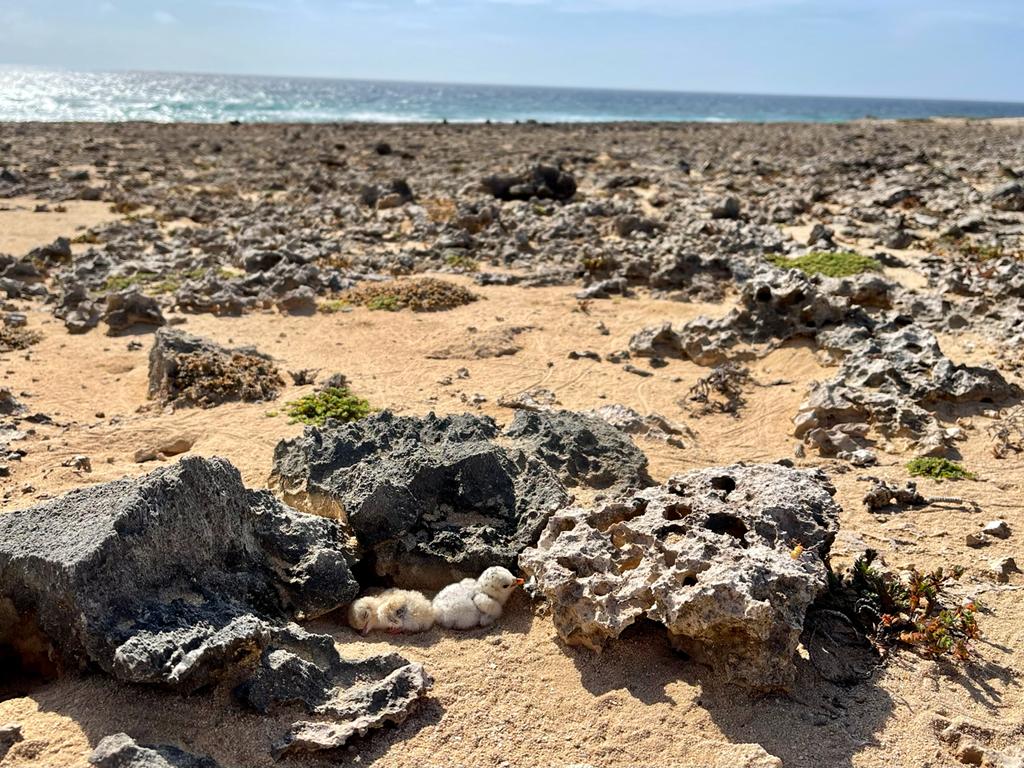
The terns also lay eggs along the north coast of our island, between cliffs and rocks throughout the area. This is where they are vulnerable to greater danger, according to ACF. Among these cliffs, everything is well camouflaged and cannot easily be seen, even by people who are walking or driving vehicles over the rocks.
The chicks have a natural behavior to “freeze” in place when they sense danger. This puts them at risk of being stepped on. For this reason, ACF is making a call to the community and authorities to help protect our historic birds.
As general advice, ACF says to keep distance and be cautious when passing through areas where terns are breeding. “If a tern starts screaming at you, that is a sign that you are too close to their nest and eggs,” Silva explained. These are the types of signals the Aruba community needs to be aware of.
So once again, a call goes out to the entire community of Aruba: Let’s protect our terns during an important season for them. Educate yourself and others about the birds, stay alert to harmful activities near nests, and share information with ACF if you notice anything unusual in nature. Together we can care for and strengthen our nature, and that begins with education.
Aruba Conservation Foundation (ACF) can be reached by phone at 585-1234 or by email at info@acf.aw