

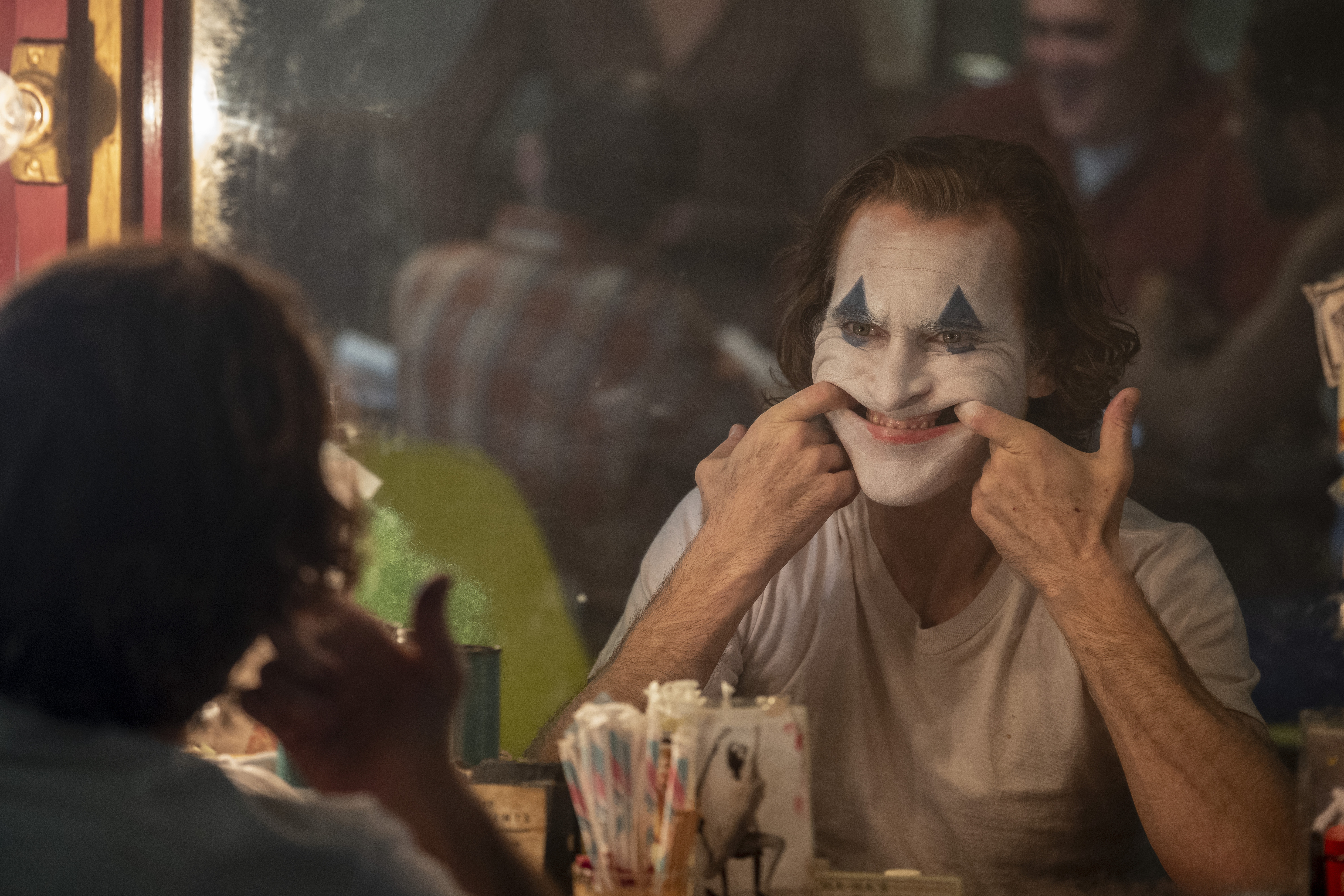




An air of menace and a cloud of controversy accompany the arrival of Todd Phillips’ “Joker” like a thick perfume. That, in itself, could be something to celebrate. Danger isn’t a quality often found in the sanitized corporate-made movies of today, least of all in the safe, fan-friendly world of comic-book films.
“Joker,” though, is a calculatedly combustible concoction, designed, like its chaos-creating character, to cause a stir. To provoke and distort. I wish it was as radical as it thinks it is.
Instead, “Joker” is a mesmerizing, misjudged attempt to marry the madness of a disturbed individual to today’s violent and clownish times. It’s a shallow, under-examined movie that renders the dark descent of a troubled man with an operatic fervor. That this feels so familiar, like the backstories of countless unhinged gunmen that so populate our tragedy-filled newspapers, could be seen as a powerful and grim reflection of today. Since the film has already so stuck a nerve, perhaps it is. But conjuring psychosis for the sake of a pre-determined origin story, make “Joker” feel cavalier and opportunistic. Its danger, really, is no deeper than a clown’s make-up.
The template of “Joker” isn’t anything from the comics (Phillips wrote the film with Scott Silver) but a pair of Martin Scorsese films about twisted loners: “Taxi Driver” and “The King of Comedy.” To make the point, Phillips has cast Robert De Niro, the star of both of those films, as a late-night host whose show Arthur Fleck (Joaquin Phoenix), our Joker-to-be, dreams of being on. Phillips, the maker of male comedies about clung-to adolescence (“Road Trip,” “Old School,” “The Hangover”), has elevated the Joker from DC Comics villain to ‘70s-movie anti-hero.
The Arthur we meet is a clown-for-hire and a wannabe stand-up. In the opening scene, he’s caking his face with makeup in front of a mirror. His smile already has a plainly forced, unnatural form. It’s the crooked outward manifestation of Arthur’s anguish. Laughter is the symptom of his heavily medicated disturbia (“All I have is negative thoughts,” he tells his social-services case worker), a product, we learn, of a childhood of abuse. To those who look at him strangely he hands a card informing them that he laughs inappropriately, like a condition of Tourette’s.
We are, immediately, in a realm very far from the spandexed world of superhero movies. Where there is usually superficial shine, in the human-sized, adult-oriented “Joker” there is grit and grime. It’s 1981 in Gotham, but the fictional city has never been so unmistakably New York, home also to Scorsese’s Travis Bickle and Rupert Pupkin. Due to a strike, garbage has piled up on the sidewalks. Reports of “super rats” have hit the tabloids. While twirling a sign on the sidewalk (“Everything Must Go”), Arthur is harassed by a group of teenagers and then beaten and mugged in a nearby alleyway.
For Arthur, everything has already gone. His life is pitiful and unrelentingly bleak. Athur lives with his mother (Frances Conroy). His tenuous grip on employment slips away when a gun, given to him by a coworker after the mugging, slides out of his pants while entertaining children at a hospital.
Phoenix, among the finest actors working, is dramatically thinner here, turning him sinewy and sinister. His face and movement holds the movie together. It’s impossible to look away from an actor so fully, so hypnotically throwing himself into a character, even if there’s an acting-class self-consciousness to the whole production _ one surely indebted in spirit to Heath Ledger’s whole-body transformation in “The Dark Knight.” But Phoenix has also been better with similarly broken souls in films like “The Master” and “The Immigrant.”
In close-up, Phoenix’s smiles are ghastly. He chokes on his laughter. He’s been raised to smile through pain, tragically divorcing himself from expressing his emotions.
“Joker” is driven not by any outside force but the ominous sense of something bad welling up in the unloved Arthur. Having won our sympathy through endless indignities, we begin to almost root for him to lash out. When he does, one night on a nearly empty subway (a subterranean gloom pervades the whole film), Arthur has, in a troubling way, self-actualized. This is, of course, who he’s meant to be. And it’s that leap, from self-pity wallowing to wanton revenge meted out on a sick society, that has made “Joker” rightfully debated. Rather than surround Arthur’s horrifying transformation with context, alternatives or rays of light _ whether they fall on him or not _ “Joker” simply hitches a ride on his freefall in mania.
There’s a moment when the film could have charted a different path toward a deeper character study. Instead, it gets on with what needs to happen, the chaos necessary to unlock, with a cold-blooded smothering and point-blank shooting. Arthur’s pain and psychosis has been offered up, in the end, not to lead to any understanding of his condition, but for its violent release, and to link to the required comic-book architecture.
It’s a testament to the potency of Phillips’ vision that “Joker” has already become such a talking point. Phillips and Phoenix have made something to reckon with, certainly, and that alone makes it a bold exception in a frustratingly safe genre. But its biggest danger is in not illustrating but catering to a world gone mad. You have to ask, in the end, why so serious?
“Joker,” a Warner Bros. release, is rated R by the Motion Picture Association of America for strong bloody violence, disturbing behavior, language and brief sexual images. Running time: 122 minutes. Two stars out of four.q
___