

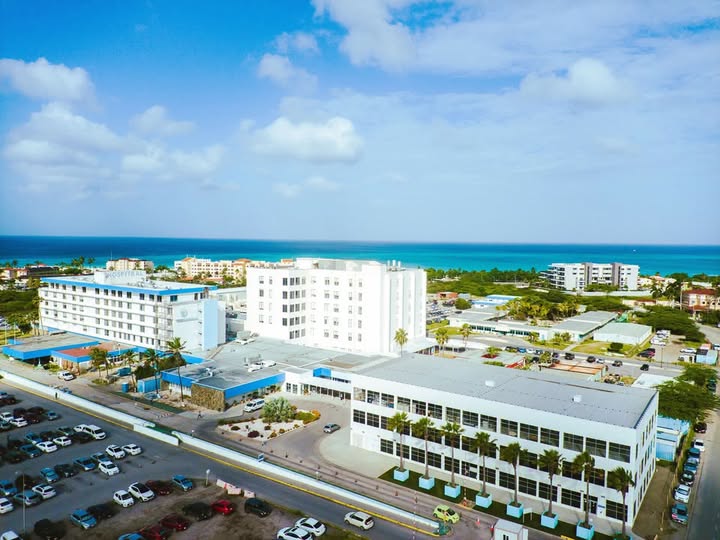




A dispute over hospital funding becomes a test of national leadership when uncertainty threatens patients’ access to treatment. Aruba’s immediate priority must be a binding, fully funded agreement that protects essential hospital care while independent experts examine the disputed costs.
Public reporting already makes the urgency clear. In September, Jacco Vroegop, director of Horacio Oduber Hospital, told NoticiaCla that talks had been underway since February without a concrete resolution. He attributed the pressure to rising demand and higher costs, saying money earmarked for modernization had been used to cover shortfalls. These are the hospital’s explanations, and they require independent scrutiny. They nevertheless demand a timely response.[1]
AZV has also outlined the steps it has taken. In a public statement to Aruba Native on September 11, the agency said it had provided 16 million Aruban florins (AWG) in advance payments since February and was considering additional support pending joint studies.[2] On October 2, 24ora reported the government’s position: Costs must be investigated while the quality and accessibility of care are maintained, without cutting services.[3]
Those positions leave one practical question unanswered: What funded arrangement will turn those assurances into care people can count on?
Bridge funding with safeguards
Within 72 hours, the government, AZV and SZA, the foundation that runs the hospital, should agree on a 90-day plan to maintain care. This is a proposed deadline, intended to bring urgency and accountability to the response.
The amount should be determined by a verified 13-week cash-flow forecast that accounts for existing payments and advances. The plan should cover essential staff, medications, diagnostics and supplies, along with the resources needed to safely restore capacity cut for financial reasons. Immediate needs must be distinguished from accumulated, disputed claims.
An initial payment based on verified figures should go ahead while the remaining numbers are reconciled. Funds should be released in monitored installments, with clear rules on eligible expenses and subsequent reconciliation. The agreement must preserve each party’s position on disputed obligations from the past.
The ministers of health and finance should identify the legal budgetary authority for the arrangement, the source of the funds and the implications for public finances. AZV should specify its contribution and payment schedule. SZA should publish a clinically reviewed recovery plan that assigns operational responsibilities to named individuals. An independent financial reviewer should track spending, while the Health Inspectorate assesses safety and access within its mandate.
Patients need information, too. A publicly available dashboard, updated weekly, should show cancellations, wait times, available treatment capacity, critical supply disruptions and overdue payments, without disclosing personal medical information.
A formal review after 30 days should establish whether the funding is actually restoring services. Before the arrangement expires, the parties should approve either a sustainable successor or a justified extension. A temporary agreement must not lead to another financial cliff that everyone can see coming.
Delay carries a cost
Protecting emergency care alone is an inadequate policy goal. Some treatments are time-sensitive long before a patient reaches the emergency department.
A systematic review in The BMJ found an association between treatment delays and higher mortality across several cancer treatment indications.[4] That research does not establish that Aruba’s financial dispute has caused deaths. It does show why the clinical consequences of waiting must be weighed alongside the financial calculations.
There are budget risks as well. Deferred treatment may require more complex procedures later. Limited capacity can increase reliance on care abroad. Those potential costs should be measured locally, along with transportation, staffing, lost work time and the expense of clearing accumulated backlogs. Spending postponed today cannot automatically be booked as savings.
Public finances deserve a fuller explanation
In its response to the second-quarter budget execution report, Aruba’s Board of Financial Supervision (CAft) recorded a provisional financing surplus of AWG 412 million for the collective sector and a surplus of AWG 45 million at AZV through that quarter.[5]
These figures do not constitute a freely available hospital rescue fund. Cash availability, reserves, existing commitments, budgetary authority and debt obligations must all be considered. The same oversight body stressed the importance of debt reduction and identified shortcomings in the financial reporting of several public institutions.
But favorable reported results make a transparent explanation essential. The government and AZV should show which funds can lawfully support continuity of care, which amounts are already committed elsewhere and what adjustments would be needed. The hospital must substantiate its costs, receivables, purchasing decisions and recovery plan.
Public funds and hospital spending both deserve scrutiny. Neither that scrutiny nor the negotiations should leave patients without a working arrangement to keep care available.
Establish who pays for care
One publicly identified point of contention concerns treatment for people not covered by AZV. In September, Aruba.nu reported Vroegop’s claim that more than AWG 29 million in unpaid care for undocumented residents had accumulated.[6] That is the hospital’s reported claim, not a fact established by a court. The government has said the figures must be examined.[3]
Aruba should establish an explicit budget mechanism for a defined scope of medically necessary care for people without AZV coverage. It should be accounted for separately, with clear eligibility rules, verified reimbursements and transparent reporting. Historical claims should be reconciled separately from payment for current treatment.
People who need urgent care should receive it within a clear funding framework. The institution providing that care should know which entity bears the cost.
Building for the next 25 years
The immediate agreement should launch a national health compact for 2027–2051, backed by all political parties and translated into fully funded five-year programs.
From 2027 to 2031, Aruba should establish reliable data on costs and care delivered, multiyear purchasing agreements, workforce planning and a funded maintenance and replacement schedule. Contracts should distinguish the cost of keeping essential care available from payments for treatment, with transparent adjustments as demand and costs change.
Governance must assign responsibilities clearly. The government should set policy and funding priorities; AZV should purchase care against defined access and quality requirements; providers should account for the care they deliver and its cost; and independent oversight should assess safety and financial management. Appointments should follow publicly stated qualification criteria, with disclosure of conflicts of interest and meaningful patient representation.
From 2032 to 2041, investment should increasingly connect hospital services with primary care, prevention, chronic disease treatment and management, rehabilitation and care for older adults. Funding should reward measurable access and quality without encouraging unnecessary treatment or the avoidance of patients with complex needs.
From 2042 to 2051, capacity and funding should be reassessed against updated projections for population trends, disease patterns and staffing. Regional partnerships should support services Aruba cannot safely or affordably sustain on its own. Technology investments must demonstrate clinical value, feasible staffing requirements and their full lifetime costs.
The compact should be reviewed every five years. Its purpose is to maintain a steady course as circumstances change.
Aruba can protect patients while demanding reliable numbers. Its leaders must now publish the funding decision, the timetable for restoring services and the names of those responsible for delivering it. Patients need an agreement they can trust.
Public sources
[1] NoticiaCla, September 17, 2026: The hospital has been in talks since February, but a solution remains elusive as October approaches.
[2] Aruba Native, September 11, 2026: AZV statement on HOH.
[3] 24ora, October 2, 2026: Government, HOH and AZV work on hospital costs.
[4] Hanna et al., The BMJ, November 4, 2020: Mortality due to delays in cancer treatment.
[5] CAft: Response to Aruba’s second budget execution report for 2026, letter dated August 28, published August 31.
[6] Aruba.nu, September 20, 2026: HOH prepares legal proceedings over unpaid care.