





By Leah Mason
Environment Desk
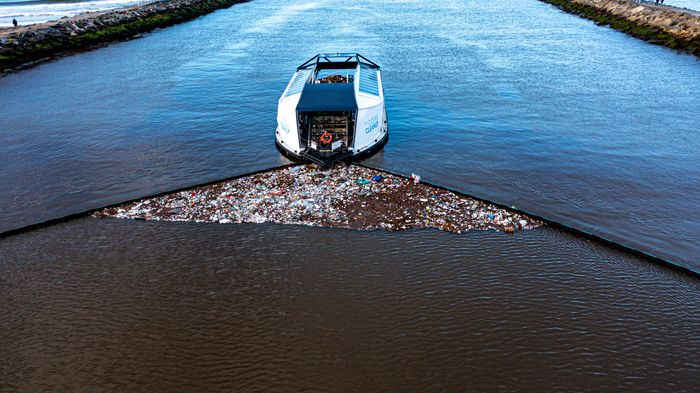
LOS ANGELES, CA — Standing at the concrete mouth of Ballona Creek just before it empties into the Pacific Ocean, a dramatic dividing line cuts cleanly through the water. On the upstream side, a massive, multi-colored blanket of compressed plastic water bottles, single-use bags, and floating Styrofoam chunks stretches across the surface. On the downstream side, the water flows remarkably clear into Santa Monica Bay.
This floating defense system is Interceptor 007, a fully automated, solar-powered trash collection catamaran developed by the Dutch non-profit research organization The Ocean Cleanup. This technology forms the front line of an aggressive new environmental strategy: capturing plastic waste directly inside coastal rivers and storm channels before it can ever reach the open sea.
With recent expansions mapping out new barrier networks along the adjacent Los Angeles and San Gabriel rivers, local engineers are proving that the tidal wave of urban marine pollution can be successfully throttled at the source.
Choking the source, saving the seas
For decades, marine biologists have warned that cleaning up open ocean waste patches—like the infamous Great Pacific Garbage Patch—is an uphill battle. Peer-reviewed research from The Ocean Cleanup has established that roughly 80% of all global ocean plastic emissions originate from just 1,000 highly polluted rivers and storm channels.
When seasonal rainstorms pummel dense coastal cities, urban trash from streets and alleys is washed down concrete storm drains, turning local rivers into literal conveyor belts for garbage.
“Trying to catch plastic once it enters the open ocean is like trying to vacuum during a hurricane,” said Boyan Slat, founder and CEO of The Ocean Cleanup. “It scatters, breaks down into toxic microplastics, and embeds itself into the marine food chain. If you want to solve the crisis, you have to intercept the trash at the mouth of the river, before the current carries it away.”
The physics of high-volume defense
The technology behind Interceptor 007 relies on a brilliant mix of natural water mechanics and automated engineering. The vessel uses two long, flexible floating booms that form a wide V-shape across the creek. As the river current flows naturally toward the sea, the booms funnel the floating trash directly into the “mouth” of the barge.
Inside the automated vessel, a solar-powered conveyor belt silently lifts the gathered plastic out of the water and distributes it evenly into six internal dumpsters. When the onboard computers register that the dumpsters are full, an automated text message notifies local public works crews to tow the barge to shore, empty the containers, and sort the debris for regional recycling facilities.
The pure scale of the technology was put to the ultimate test during record-breaking atmospheric river storms that slammed Southern California. The extreme storm runoff washed a colossal wave of city trash down the county’s concrete channels all at once. During a single 24-hour peak rain event, the device successfully trapped over four tons of trash, single-handedly preventing it from washing onto local beaches.
Since its initial pilot deployment, Interceptor 007 has blocked more than 193.5 tons (386,945 pounds) of garbage from entering the Pacific Ocean, prompting the Los Angeles County Board of Supervisors to unanimously approve its transition into permanent, year-round operation.
Scaling up the blueprint
The success in Southern California has served as a critical proof-of-concept for similar initiatives across the state and the globe. Further south, the California State Water Resources Control Board deployed a 450-foot heavy-duty trash boom across the Tijuana River Valley. This regional line of defense targets thousands of cubic yards of cross-border plastics and discarded tires, shielding vulnerable South Bay marine ecosystems from catastrophic pollution.
These localized deployments feed directly into a grander global vision known as the 30 Cities Program. By standardizing and scaling up these automated river barriers across 30 of the world’s most heavily polluted coastal urban hubs, environmental scientists estimate they can successfully cut global river-to-ocean plastic emissions by one-third by the end of the decade.
As the sun sets over the Pacific, the solar-powered conveyor belt on Ballona Creek continues its quiet, methodical work. For the first time in decades, environmental conservationists aren’t just reacting to the ocean plastic crisis—they are actively winning the battle at the shore.