
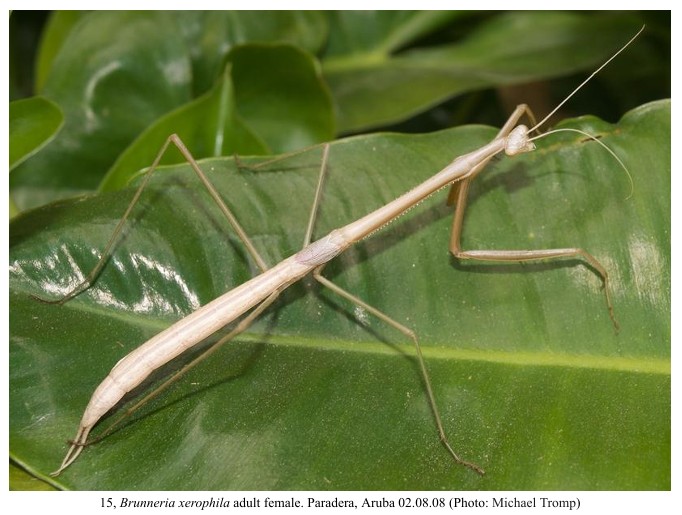




News has recently emerged that a new species of praying mantis has been discovered in Aruba. First reported by the news outlet Nature Today, the discovery came after several posts on the website iNaturalist showed photos of a praying mantis that had not yet been identified by scientists.
Aruba a “gap in the inventory” until now
Before this discovery, Aruba was considered a gap in the inventory of praying mantises in the Caribbean, according to expert Kris Anderson of Cornell University in the United States, who stated this in a report published this year. This is because Aruba had no confirmed records of praying mantises based on earlier specimen research. In a separate study in 2025—conducted by the same author—the Aruban species was mentioned, but this was based only on photographs of the species and not on taxonomic observations of the insect.
On November 25, 2025, a collection expedition was carried out for this species. Led by Luc Willemse, researchers and members of Naturalis collected a few specimens in Arikok National Park and deposited them in the Biodiversity Center museum. This collection marked the first physical record of a mantis documented in Aruba.
Notably, the expedition team observed that the species discovered in Aruba showed similarities to a praying mantis species informally designated Brunneria, previously found in Brazil. It was Willemse who invited Anderson to formally describe the species.
Classifying the mantis was not easy
According to Anderson in his report, classifying this new species was not as straightforward as expected. In fact, it resulted in a complete reevaluation of the entire group.
The main issue, researchers said, was that the identification system for the Brunneria group was inconsistent. For example, many characteristics of the group varied depending on perspective, available lighting during observation, and even the sex of the specimen. This made the system unreliable for accurate classification, leading researchers to conclude that the framework needed revision.
To rebuild the classification framework, scientists used an approach focused on morphometric analysis, measuring features such as torso length, wings, and proportions between body segments. They also conducted anatomical analysis, focusing on patterns that distinguish species and antenna structure. Researchers quickly found that these methods allowed them to distinguish species more accurately, making the system more reliable.
To classify the mantis species found in Aruba, the collected specimens were compared with the newly revised framework. They were also compared with other species found in Latin America, including those that may have been misclassified in the past, as well as with other specimens from the Brunneria group.
What they discovered was remarkable: the Aruban specimens showed several unique characteristics. For example, they were smaller compared to other related specimens. Their body proportions were also different, and researchers observed a specific pattern in the small tooth-like structures on their bodies.
Another key finding was that these specimens had adapted to Aruba’s hot, dry climate. For this reason, Anderson named the species Brunneria xerophila. As explained in Nature Today, “xerophila” is a Greek word meaning “lover of dryness,” referring to the dry climate of Aruba in which the species appears to thrive.
So far, this new species is known only in Aruba. The species Brunneria xerophila has shown the ability to adapt to a dry climate with little rainfall. At the same time, it may be at risk, as scientists consider it ecologically isolated. In other words, it is separated from the American continent by the sea surrounding the island. There is currently no estimate of how many specimens exist on the island, but isolation could lead to reduced gene flow or cause the species to evolve in a unique way. Isolation could also result in the species becoming endemic, especially if no conservation efforts are made.
This discovery shows that even though we are a small island, new discoveries can still be made every day, helping us learn more about our natural environment. It also highlights how much of Aruba’s biodiversity remains undocumented.
This is where the Aruba Conservation Foundation plays an important role. ACF, together with the Naturalis Biodiversity Center, collaborates on conservation work, mapping Aruba’s biodiversity more effectively. As the organization legally responsible for protecting species on the protected list, ACF carries the responsibility of maintaining healthy populations of these animals—together with volunteers from the community.
Source and photos: Anderson, K. (2026): Two New Species of Brunneria Saussure, 1869 (Mantodea: Coptopterygidae) with Novel Diagnostic Characters and a Key to the Species. Soothsayer, Journal of Mantodea Research. 7 (1): 55–88.