





By Jesse Bedayn
Associated Press
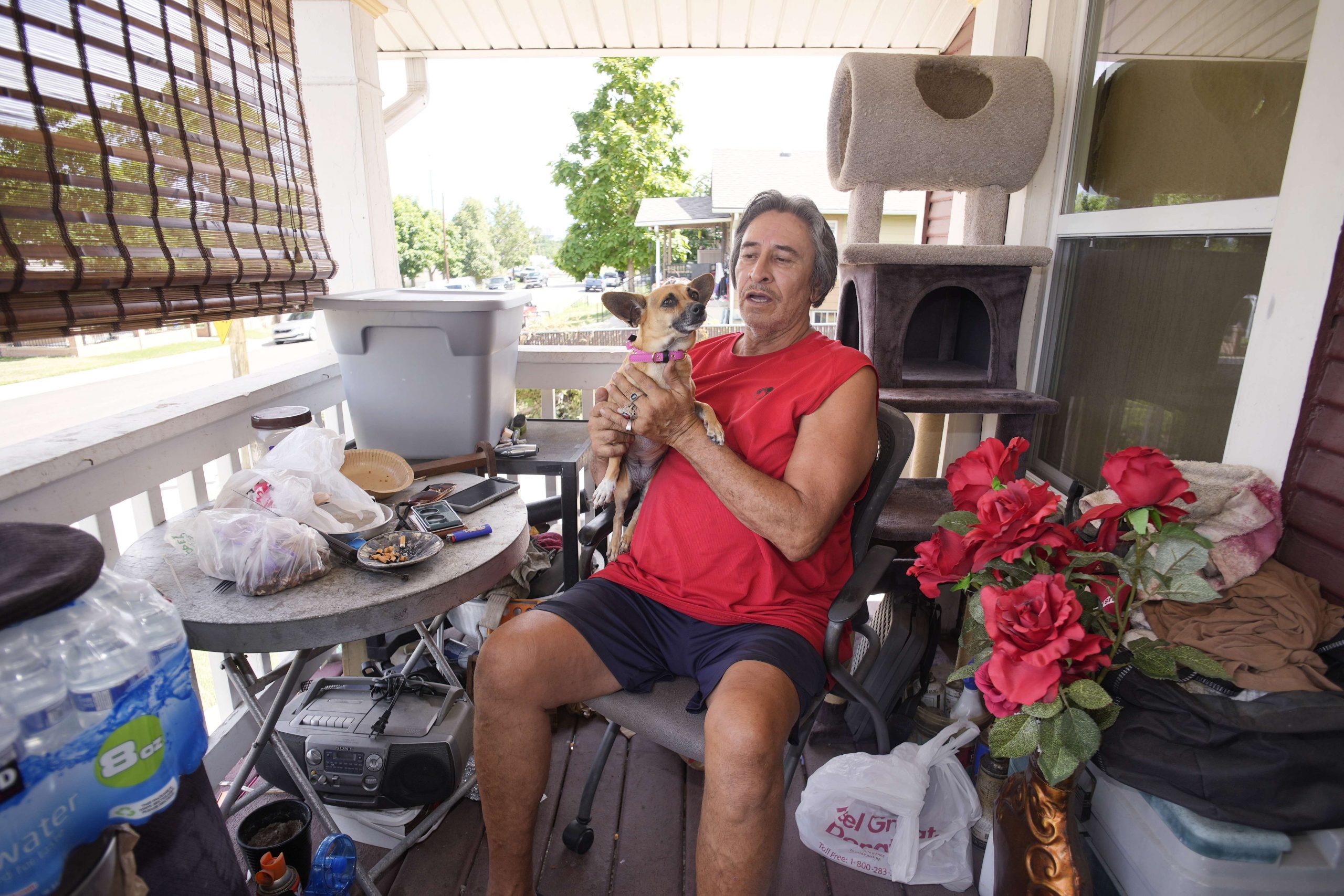
DENVER (AP) — As Denver neared triple-digit temperatures, Ben Gallegos sat shirtless on his porch swatting flies off his legs and spritzing himself with a misting fan to try to get through the heat. Gallegos, like many in the nation’s poorest neighborhoods, doesn’t have air conditioning.
The 68-year-old covers his windows with mattress foam to insulate against the heat and sleeps in the concrete basement. He knows high temperatures can cause heat stroke and death, and his lung condition makes him more susceptible. But the retired brick layer, who survives on about $1,000 a month, says air conditioning is out of reach.
“Take me about 12 years to save up for something like that,” he said. “If it’s hard to breath, I’ll get down to emergency.”
As climate change fans hotter and longer heat waves, breaking record temperatures across the U.S. and leaving dozens dead, the poorest Americans suffer the hottest days with the fewest defenses. Air conditioning, once a luxury, is now a matter of survival.
As Phoenix weathered its 27th consecutive day above 110 degrees (43 Celsius) Wednesday, the nine who died indoors didn’t have functioning air conditioning, or it was turned off. Last year, all 86 heat-related deaths indoors were in uncooled environments.
“To explain it fairly simply: Heat kills,” said Kristie Ebi, a University of Washington professor who researches heat and health. “Once the heat wave starts, mortality starts in about 24 hours.”
It’s the poorest and people of color, from Kansas City to Detroit to New York City and beyond, who are far more likely to face grueling heat without air conditioning, according to a Boston University analysis of 115 U.S. metro areas.
Some have window units that can offer respite, but “in the dead of heat, it don’t do nothing,” said Melody Clark, who stopped Friday to get food at a Kansas City, Kansas, nonprofit as temperatures soared to 101. When the central air conditioning at her rental house broke, her landlord installed a window unit. But it doesn’t do much during the day.
So the 45-year-old wets her hair, cooks outside on a propane grill and keeps the lights off indoors. At night she flips the box unit on, hauling her bed into the room where it’s located to sleep.
As far as her two teenagers, she said: “They aren’t little bitty. We aren’t dying in the heat. … They don’t complain.”
While billions in federal funding have been allocated to subsidize utility costs and the installation of cooling systems, experts say they often only support a fraction of the most vulnerable families and some still require prohibitive upfront costs. Installing a centralized heat pump system for heating and cooling can easily reach $25,000.
President Joe Biden announced steps on Thursda y to defend against extreme heat, highlighting the expansion of the Low Income Home Energy Assistance Program, which funnels money through states to help poorer households pay utility bills.
While the program is critical, said Michelle Graff, who studies the subsidy at Cleveland State University, only about 16% of the nation’s eligible population is actually reached. Nearly half of states don’t offer the federal dollars for summer cooling.
As temperatures rise, so does the cost of cooling. And temperatures are already hotter in America’s low-income neighborhoods. Researchers at the University of San Diego analyzed 1,056 counties and in over 70%, the poorest areas and those with higher Black, Hispanic and Asian populations were significantly hotter. That’s in part because those neighborhoods lack tree coverage.