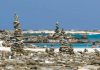

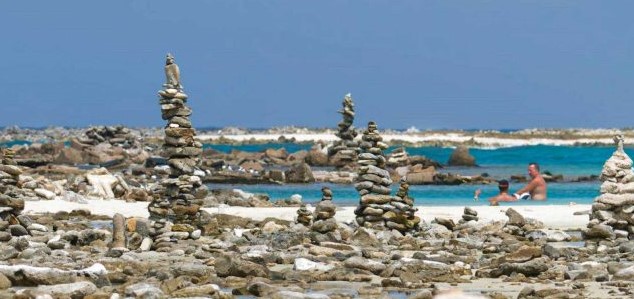




(Oranjestad)—Recently on social media, a video began circulating showing a tour operator in Aruba taking action against stacked rocks by knocking them down. The video received mixed reactions. However, both locals and tourists supported the action, mainly due to the negative impact that stacking rocks has on our ecosystem and nature.
To understand the growing opposition to the practice of stacking rocks, it is necessary to understand the deep and negative impact behind it. The act, called rock stacking, has been practiced for thousands of years and was originally used to guide people on hikes or travelers in mountainous regions, as well as for rituals, burials, and memorials. However, the modern trend is quite different. Today, the popularity of rock stacking has less to do with utility and tradition and more to do with social media. An American artist based in Colorado, Michael Grab, noted that the trend really began gaining popularity around 2014 and 2015, before it exploded and became an international art form.
The reasons behind participation vary widely, ranging from something purely practical or a tradition from the past, to an activity for its “beauty.” For many, it is about leaving a mark, creating “art,” or simply enjoying the process of balancing rocks. In recent times, those who participate in this—especially in Aruba—do so to leave proof of their presence or simply to post on social media.
Although it may seem harmless, there are several problems and negative impacts behind it. One of these is that many animal species hide under rocks to live, reproduce, or escape predators. If you move a rock, you may be destroying a home. If you stack one on top of another, you may expose prey to predators. Whether this is done in nature areas, along the coast, or in desert environments, it can destroy entire colonies and, in the worst case, threaten species that are already endangered.
There are microorganisms and small species such as insects or certain snakes that live in the soil beneath rocks commonly used for stacking. These rocks help trap moisture underneath, allowing the ecosystem to sustain itself. When you remove a rock, the soil is exposed and the moisture can dry up, killing all living organisms that depend on that humid environment.
Additionally, each rock is full of life—everything from aquatic plants to microorganisms attaches to them. Especially when it comes to rocks near the sea, they create habitats for some marine animals. Holes in the rocks can hold eggs, supporting them until the animals hatch. An expert explained that removing rocks from a fragile environment is essentially the equivalent of removing bricks from someone’s house while also taking everything out of their refrigerator.
There is also the issue of erosion and soil damage, because rocks help hold the ground in place, sealing the surface and helping manage excess water, even allowing new life to grow. When these rocks are removed, the soil becomes loose, significantly increasing the rate of erosion in that area.
This erosion can cause sedimentation in nearby bodies of water, negatively impacting aquatic habitats and water quality.
Rocks along the coast are part of a natural ecosystem and play an important role in protecting the shoreline from erosion and the force of the ocean. When people remove or stack rocks, it affects coastal stability, increases the risk of erosion, and damages ecosystems. According to South African National Parks, this is particularly relevant for an island like Aruba—especially considering that most, if not all, rock stacking on the island takes place near coastal areas.
It is understandable that rock stacking may seem like a fun activity to do while off-roading; however, the survival, protection, and conservation of the island are just as important—if not more so—to ensure that in the future there will still be an island for both locals and visitors. We want our visitors to appreciate what Aruba has to offer—in a healthy and sustainable way.