




By Mark Sherman
Associated Press
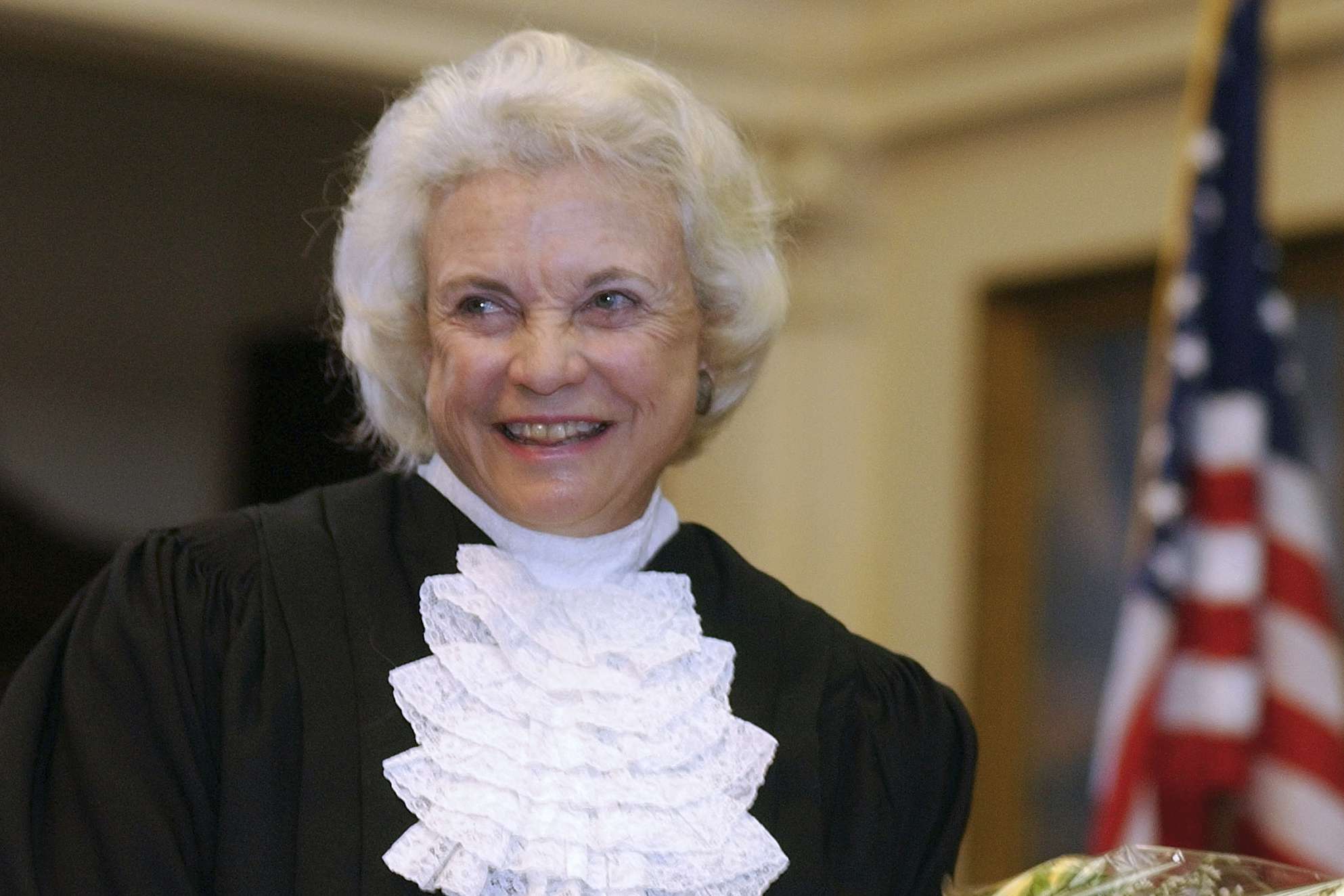
WASHINGTON (AP) — Retired Supreme Court Justice Sandra Day O’Connor, an unwavering voice of moderate conservatism and the first woman to serve on the nation’s highest court, died Friday. She was 93.
O’Connor died in Phoenix, of complications related to advanced dementia and a respiratory illness, the Supreme Court said in a news release.
Chief Justice John Roberts mourned her death. “A daughter of the American Southwest, Sandra Day O’Connor blazed an historic trail as our Nation’s first female Justice,” Roberts said in statement issued by the court. “She met that challenge with undaunted determination, indisputable ability, and engaging candor.”
In 2018, she announced that she had been diagnosed with “the beginning stages of dementia, probably Alzheimer’s disease.” Her husband, John O’Connor, died of complications of Alzheimer’s in 2009.
O’Connor’s nomination in 1981 by President Ronald Reagan and subsequent confirmation by the Senate ended 191 years of male exclusivity on the high court. A native of Arizona who grew up on her family’s sprawling ranch, O’Connor wasted little time building a reputation as a hard worker who wielded considerable political clout on the nine-member court.
The granddaughter of a pioneer who traveled west from Vermont and founded the family ranch some three decades before Arizona became a state, O’Connor had a tenacious, independent spirit that came naturally. As a child growing up in the remote outback, she learned early to ride horses, round up cattle and drive trucks and tractors.
“I didn’t do all the things the boys did,” she said in a 1981 Time magazine interview, “but I fixed windmills and repaired fences.”
Following her retirement, O’Connor expressed regret that a woman had not been chosen to replace her. O’Connor remained active in the government even after she retired from the court. She sat as a judge on several federal appeals courts, advocated for judicial independence and served on the Iraq Study Group. She also was appointed to the honorary post of chancellor at the College of William and Mary in Virginia.
O’Connor cited her husband’s struggle with Alzheimer’s disease as her primary reason for leaving the court. After moving into an assisted living center, John O’Connor struck up a romance with a fellow Alzheimer’s patient, a relationship experts say is not uncommon among people with dementia. The retired justice was relieved that he was comfortable and happy at the center, according to her son, Scott.
On the bench, O’Connor generally favored states in disputes with the federal government. She often sided with police when they faced claims of violating people’s rights. In 1985, she wrote for the court as it ruled that the confession of a criminal suspect first warned about his rights may be used as trial evidence, even if police violated the suspect’s rights in obtaining an earlier confession.
A 1991 decision written by O’Connor said police do not violate the Constitution’s ban against unreasonable searches and seizures when they board buses and randomly ask passengers to consent to being searched. In a 1994 decision, O’Connor said police officers need not stop questioning and seek clarification when a criminal suspect makes what might have been an ambiguous request for legal help.
O’Connor wrote for the court in 1992, when it said prison guards violate inmates’ rights by using unnecessary physical force even if no serious injuries result, and in 1993, when it ruled that employers may be guilty of illegal sexual harassment even in the absence of any psychological harm.
In 2004, O’Connor wrote the majority opinion that went against the Bush administration in ruling that an American citizen seized on the Afghanistan battlefield can challenge his detention in U.S. courts. “We have long since made clear that a state of war is not a blank check for the President when it comes to the rights of the Nation’s citizens,” O’Connor wrote.
O’Connor once described herself and her eight fellow justices as nine firefighters: “When (someone) lights a fire, we invariably are asked to attend to the blaze. We may arrive at the scene a few years later.”
O’Connor announced her retirement in a one-sentence written statement. She cited her age, then 75, and said she “needs to spend time” with her family. Her official resignation letter to Bush was similarly succinct. “It has been a great privilege indeed to have served as a member of the court for 24 terms,” the justice wrote. “I will leave it with enormous respect for the integrity of the court and its role under our constitutional structure.”
“For an old ranching girl, you turned out pretty good,” Bush told her in a private call not long after receiving her letter, an aide said. Then, in the Rose Garden outside the Oval Office, he praised her as “a discerning and conscientious judge and a public servant of complete integrity.”
Funeral plans were not immediately available.