
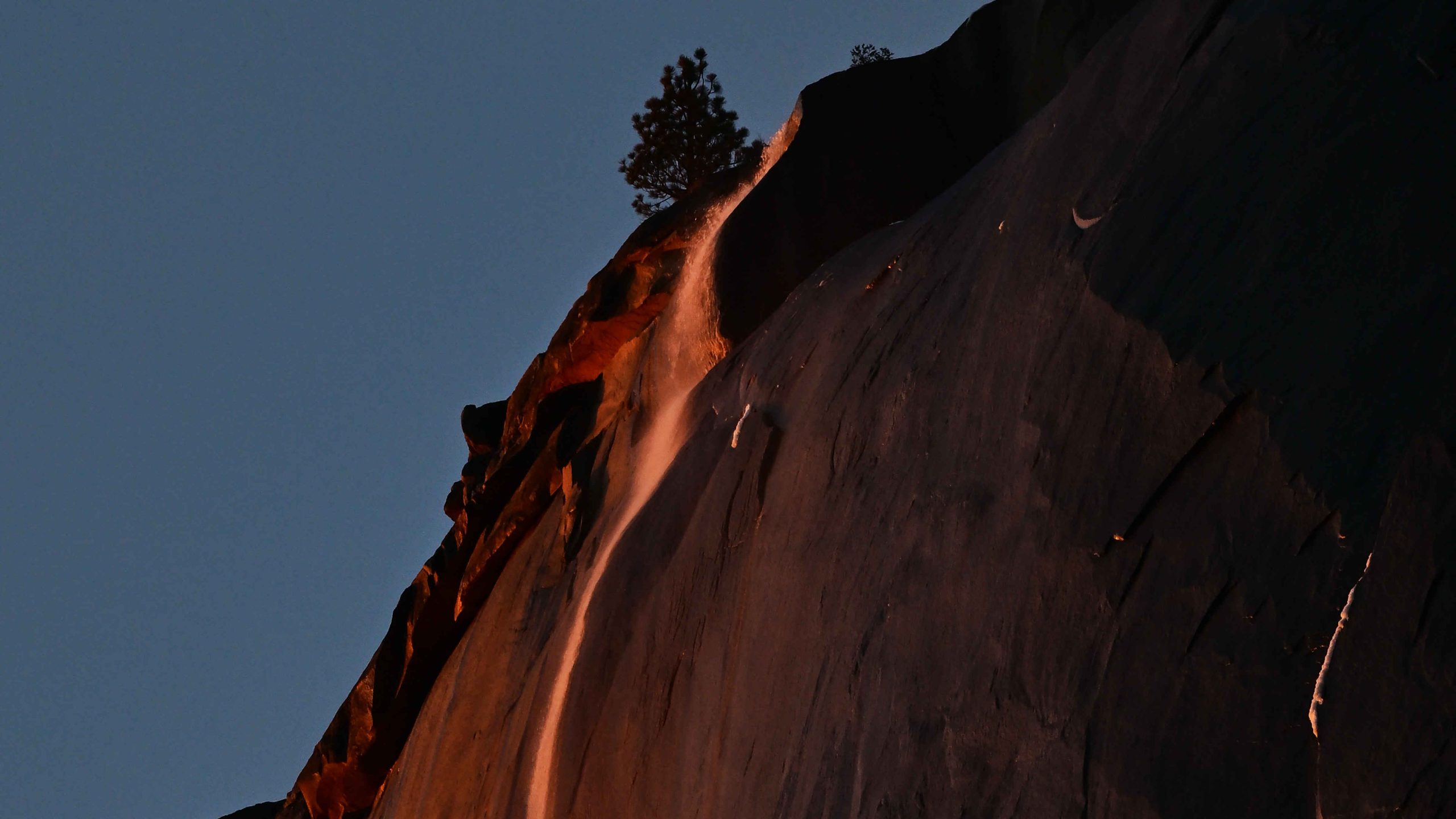




YOSEMITE NATIONAL PARK – For a few fleeting minutes each evening this week, the granite face of El Capitan appeared to bleed molten lava. The seasonal phenomenon known as the “Firefall”—a rare optical illusion at Horsetail Fall—has returned to Yosemite National Park, drawing record crowds of photographers and nature enthusiasts to witness one of the most elusive spectacles in the American wilderness.
The event occurs when the setting sun hits the seasonal waterfall at just the right angle, illuminating the plummeting water in vibrant shades of orange, red, and gold. To the naked eye, it looks less like water and more like a river of fire cascading 1,500 feet down the rock wall.
“It’s a game of celestial billiards,” said Ranger Marcus Thorne, who has managed the viewing crowds for over a decade. “You need a perfect storm of conditions: enough snowmelt to feed the fall, a clear western horizon to let the sunlight through, and the precise tilt of the Earth in late February and early March. If one cloud drifts by at 5:15 PM, the show is over before it begins.”
A legacy of light While the natural Firefall is a modern viral sensation, the name carries historical weight in the park. From 1872 until 1968, hotel operators at Glacier Point would push glowing embers of red fir bark over the edge of the cliff to create a literal man-made firefall for tourists. The National Park Service eventually ended the practice, citing it as an artificial attraction inconsistent with the mission of preserving natural wonders.
It wasn’t until 1973 that photographer Galen Rowell captured the first famous image of the natural phenomenon at Horsetail Fall, proving that nature’s version was far more spectacular than anything humans could ignite.
Managing the “kodak crush” In recent years, the Firefall’s popularity has skyrocketed due to social media, leading to significant logistical challenges for park rangers. To protect the sensitive Merced River ecosystem and prevent gridlock on the narrow valley roads, the Park Service implemented a strict reservation system for the 2026 season.
“We’ve seen thousands of people trying to cram into a few designated viewing areas,” Thorne explained. “Our goal is to ensure people see the light without trampling the very landscape they came to admire.”
Despite the crowds, the atmosphere at the El Capitan picnic area remains hushed as sunset approaches. On Tuesday evening, as the shadows lengthened across the valley floor, the fall began to glow a pale yellow. Within minutes, the color deepened into a searing, neon orange. Gasps echoed through the pines, followed by the rapid-fire clicking of hundreds of camera shutters.
A symbol of preservation Environmentalists points to the Firefall as a poignant reminder of the importance of climate stability. Because Horsetail Fall relies entirely on snowmelt, shorter winters and lower snowpacks threaten the phenomenon’s frequency.
“Seeing the Firefall is a spiritual experience for many,” said Elena Vasquez, a visitor who traveled from Chicago. “But it’s also a fragile one. It reminds us that these moments are gifts from the planet that we have to work to keep.”
As the sun dipped below the horizon, the “lava” faded back into a silver ribbon of water, leaving the crowd in the deepening blue of the Sierras. For those who missed it, the window of opportunity remains open for only a few more days before the sun’s angle shifts and the fire is extinguished until next year.