
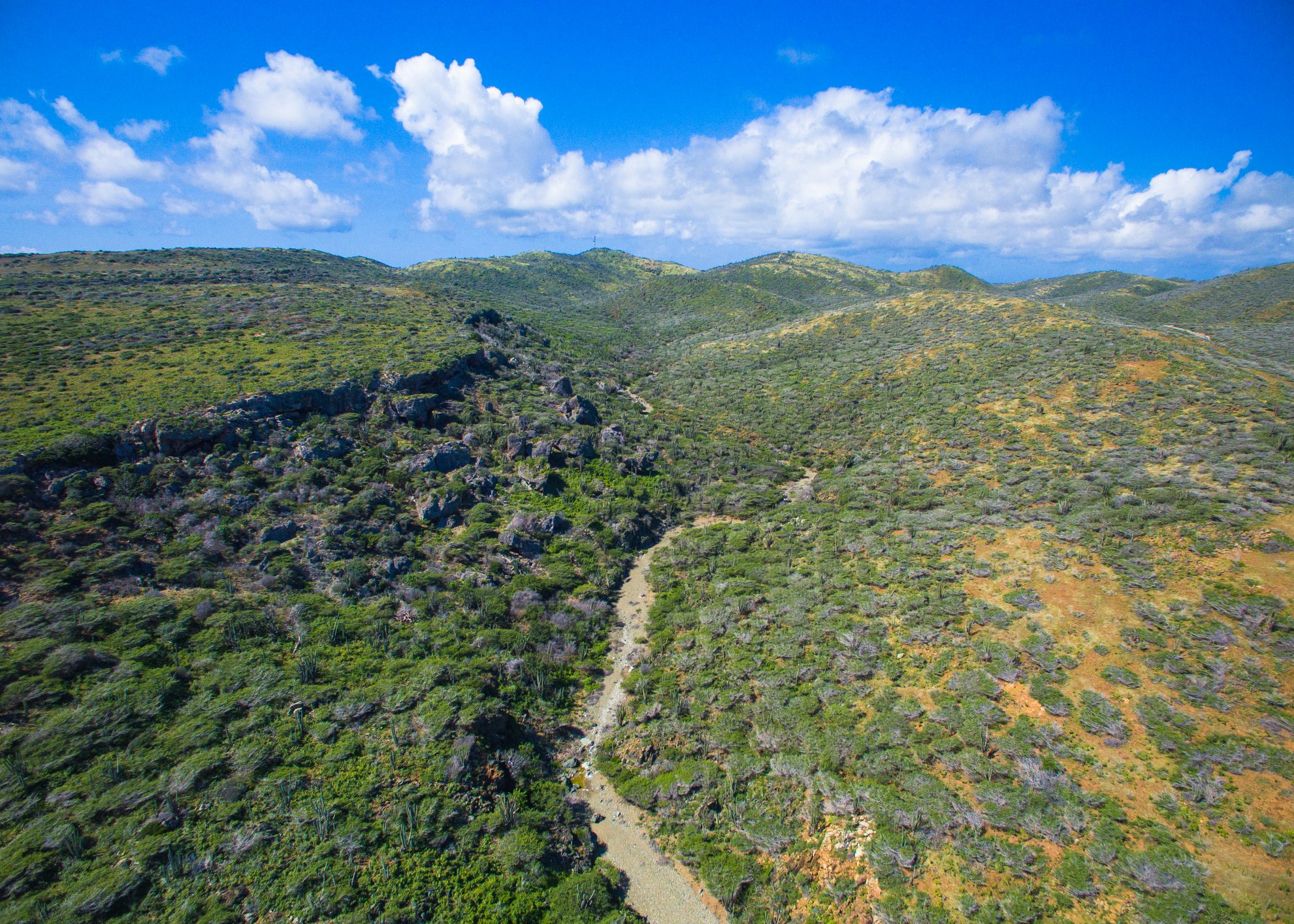



The National Park Arikok comprises almost 18 % of the island. Its rugged terrain, desert-like hills filled with tall cacti, breathtaking coastline and protected local flora and fauna welcome you to be explored. There are numerous animals to discover, for example the bright blue Cododo or mighty Warawara.
The national park Arikok takes you on a memorable journey of the islands past offering unique geological, cultural and historical sites. These can all be enjoyed and explored either on your own or during guided tours. A wide variety of educational and informative programs and fun activities is available.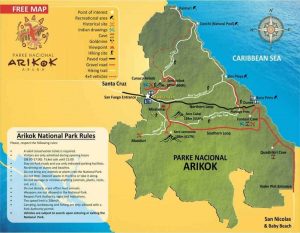
Did you know that four of the seven species of sea turtle lay their eggs on Aruba’s beaches? In the national park, a Least Tern (Sternula antillarum) keeps a strict eye on a very special event taking place below on the beach: A majestic Leatherback (Dermochelys coriacea) heading back to the ocean after laying her eggs during breeding season. Sea turtles prefer nesting in the cool and dark hours of the night. And hatchlings usually wait for the cue of cooling surface sand before emerging.
Nature Conservation
The protected area of National Park Arikok was officially established in 2000. Arikok National Park is a 34 square kilometers (7907 acres) of natural area, located at the north-eastern part of Aruba which contains examples of most of the island’s flora and fauna against a backdrop of great geological complexity. We are proud to state that approximately 18% of the total land area of Aruba is assigned as a National Park, to protect and preserve the flora, fauna, geology and historical remains present within Arikok National Park.
The Landscape
There is a great geological variety within the park. The main aspects are the rough hills of the volcanic Aruba lava formation, the mysterious rocks of the batholithic quartz-diorite/tonalite, and the limestone rocks from fossilized coral. The two tallest hills on the island are situated within the park. Jamanota hill 188 meters (617 ft) and Arikok hill 176 meters (577 ft), from which the name of the park is derived.
The line of the permanently wind-and-wave beaten North Coast is broken by several bays (boca’s). Most of them are small yet impressive inlets at the mouth of dry riverbeds. Some of these bays (boca’s) are spectacular sights, adorned with white, sandy beaches and sand dunes, as is the case at Boca Prins and Dos Playa.
Arikok is also home to Conchi, Aruba’s most important natural attraction; also known as The Natural Pool. The journey to the Pool is and adventure by itself and only possible by foot, horse, or 4×4 vehicle. As of 2020, ATV’s and UTVs are not allowed in the park due do its significant impact on nature.
Cultural and Historical components
There are a number of sites within the park that attest to the history of Aruba. The Caquetío Indians left rock paintings in Cunucu Arikok and Fontein Cave.
Old plantation (Cunucus) sites tell the story of an active yet challenging agricultural past.
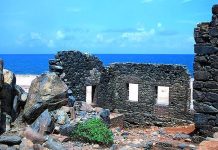
These Cunucus were also residential areas for the few families that worked the land. These families found ways to survive in the difficult conditions, and were able to erect their homes with materials found in the area. Two of these adobe houses have been restored. Park rangers are learning many of the old building techniques in order to preserve this unique Aruban mud-house. At Cunucu Arikok and near Plantation Prins you can find these adobe houses.
Park Management
The Aruba Conservation Foundation (ACF), formerly known as Aruba National Park Foundation, manages the national park. This foundation was established in July 2003. In February 2017, mangrove and wetland RAMSAR site #198 Spanish Lagoon was annexed to Arikok National Park due to its importance as a feeding and breeding area for water birds and as a nursery area for a variety of marine organisms. With this addition, the areas under management increased by 70 hectares while the amount of species of flora and fauna to be conserved to over 250. On December 21st, 2018 (AB 2018 no. 77) Parke Marino Aruba – currently consisting of four marine protected areas (MPAs) – was officially established and subsequently brought under management of ACF. In 2019, preliminary management plan for marine were introduced for Parke Marino to conserve reefs, seagrass beds, and mangrove forests and in 2020 ACF was given additional management areas such as the Saliñas (Druif, Malmok, Cerca, Palm Beach, Bubali etc.) and also additional areas such as Rooi Manonchi, Ser’I Teishi etc. Managed areas can be seen here: https://acf.aw/.
Visit the National Park Arikok to see the wonder of Aruba’s nature. The visitor center in San Fuego and entrance in Vader Piet (San Nicolas) is open daily from 8:00 AM to 16:00 PM. Contact the ACF via e-mail, info@acf.aw or call +297 585 1234 for more information.