




By JANET McCONNAUGHEY
BAY ST. LOUIS, Miss. (AP) — Deluges along Mississippi’s coast have damaged the state’s current generation of oysters two years after fresh water from a Louisiana flood control structure all but wiped out live adults on reefs. Fresh water also has hurt baby oysters in southeast Louisiana but doesn’t appear to have been a big problem in Alabama.
Mississippi oyster farmer Anita Arguelles said that at one point, fresh water was killing half of the small seed oysters that she and her husband buy to grow in raised cages at their French Hermit Oyster Co. farm off Deer Island — and those that survive were stunted.
“It has reduced the crop by at least 30% … because they’re either too small or they’re dead,” Arguelles said.
“What we’re seeing is a preponderance of runts,” she said. And they fill buckets with dead oysters each time they harvest live ones big enough to sell.
Another oyster farmer in the same area reported less serious damage. “We lost a little bit more than we usually do,” said Sam Yates of High Tide Oyster Co. “But as far as a terrible loss, no, it wasn’t really a bad year.”
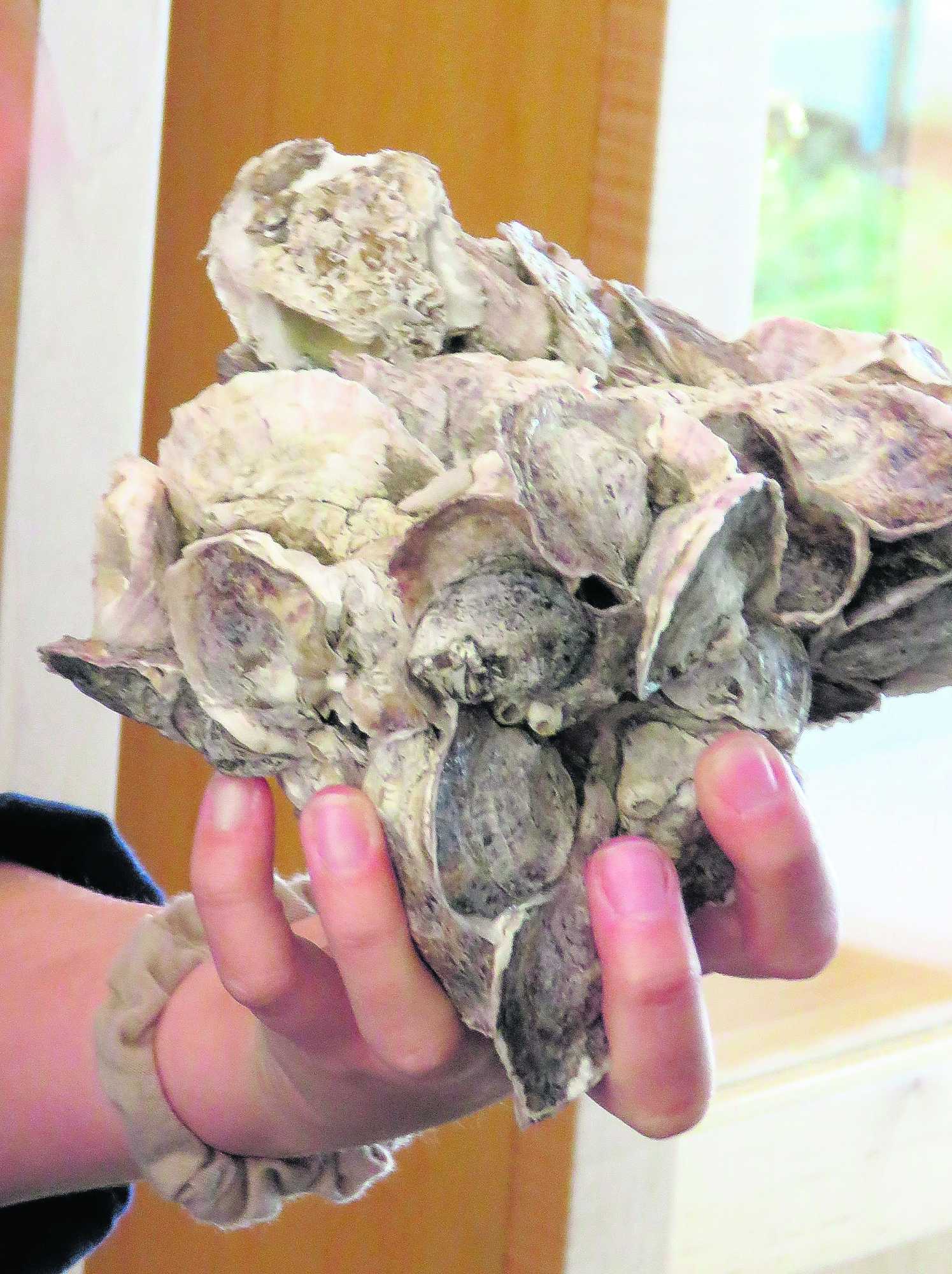
At a high school in Bay St. Louis where students raise oysters to help restore Mississippi reefs, cages that might hold fist-sized clumps of oysters after a good summer and fall held only a few small babies in mid-November. Most of the recycled shells held only silt where tiny youngsters called spat had attached themselves at a hatchery.
These are bad signs — oysters in raised cages typically grow much faster and fatter than those on the ocean floor. They can reach adult size in less than a year in Mississippi, where those growing on the bottom would need two or three years. That’s because the water around them carries more food and because people regularly remove predators, competitors, and algae, silt and oyster waste that could slow the bivalves’ growth by reducing the water’s flow.
This year’s low salinity will definitely hurt this year’s hatch and development of wild oysters, Rick Burris, chief scientific officer for the Mississippi Department of Marine Resources, said in an interview.
Louisiana biologists “did observe some spat mortality,” said Carolina Bourque, head of the oyster program for the Louisiana Department of Wildlife and Fisheries. It’s hard to say just how much, “especially with sampling only once a month, she said.
Because it takes years for wild oysters to mature, it may be a while before any effect on oyster reefs is clear.
Rains didn’t appear to affect Alabama as much. “Our spat seem to be fairly good,” said Kevin Anson, fisheries section chief in the Alabama Department of Conservation and Natural Resources.
Mississippi’s coast has had “an insane amount of rain” this year, said Eric Sparks, director of the Coastal Research and Extension Center at Mississippi State University. For instance, National Weather Service figures show the Gulfport-Biloxi Airport got 2.8 times its normal rainfall in both April and August. From April through August, that station got nearly 71 inches (1.8 meters), more than double the average.
Some splashed straight into the Mississippi Sound and some arrived via streams and rivers. And it came at critical times: during spring, when oysters spawn, and summer, when fragile youngsters start growing.
In Louisiana, a wet spring across the state — especially in Calcasieu Lake and east of the Mississippi River — slowed growth and killed some oysters, Bourque said.
Mississippi hasn’t allowed dredging on public reefs since 2018 because 96% of the oysters on them died when fresh water from the Bonnet Carre Spillway poured into the sound in 2019, Burris said in an interview.
That also hurt Louisiana’s oysters. Louisiana’s last public harvest east of the Mississippi River was from fall of 2018 into spring 2019, Bourque said.
With favorable environmental conditions and enough oyster larvae carried in from reefs where oysters are still spawning, it should have taken three to five years for Mississippi’s reefs to return to health, Burris said.
He said fresh water from “historical rainfall in our localized area” will reduce the number of baby oysters this year and slow their growth. He wouldn’t predict the size or length of this year’s setback, saying annual reef assessments will evaluate that.
Mississippi’s reefs had also been hit hard in 2011 by water from the spillway, which was created to avoid high water damage to levees protecting New Orleans.
That earlier “untimely opening” killed 80% to 85% of the oysters then growing, Burris said.
The 2011 opening was reflected in federal data as an abrupt drop from 726.4 to 123.7 tons (658.9 to 112.2 metric tons) for 2010 and 2011 landings in Mississippi.
Harvests plummeted again from 544 tons in 2016 to less than one-third of that in 2017 and to 9.5 tons (8.62 metric tons) in 2018, the federal figures showed.
Those likely resulted from 2016 and 2018 spillway openings “coupled with the agency’s management strategy of harvesting no more than 30% of available resource,” Burris said in an email.