

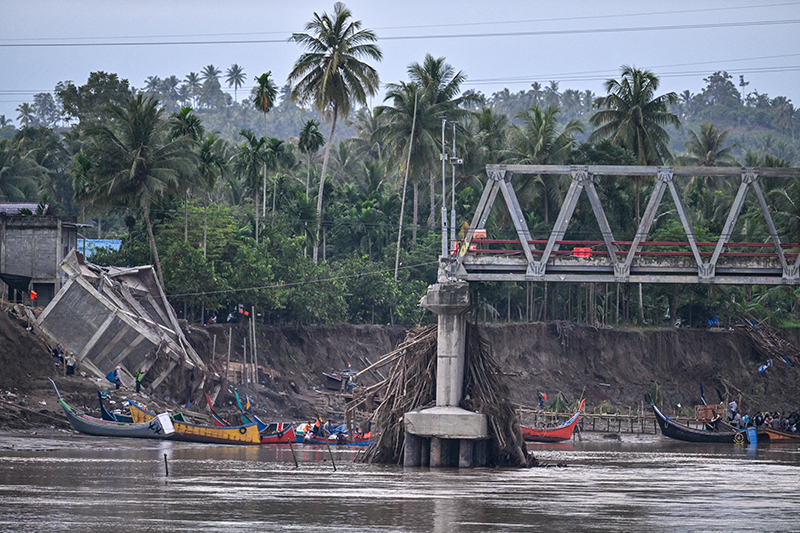




In the realm of modern engineering, the ability to “see” a disaster before it happens has long been the holy grail of public safety. As of March 2026, that vision is becoming a reality through a sophisticated marriage of orbital radar and artificial intelligence.
New research led by the University of Houston and NASA has revealed that satellites can now detect millimeter-scale structural shifts in bridges, providing an early warning system that could prevent catastrophic failures globally.
The technology: Radar that never sleeps
The primary engine behind this breakthrough is Interferometric Synthetic Aperture Radar (InSAR). Unlike traditional cameras that rely on visible light, InSAR satellites emit radar pulses that bounce off the Earth’s surface—penetrating clouds and working in total darkness.
By comparing these signals over time, scientists can measure “persistent scatterers”—stable points on a bridge’s deck or pylons—to track movement with a precision of just a few millimeters.
This technique, known as Multi-Temporal InSAR (MT-InSAR), allows for continuous oversight without the need for expensive on-site sensors. While traditional physical inspections typically occur only once every two years, satellites like the European Space Agency’s Sentinel-1 or the recently launched NASA-ISRO Synthetic Aperture Radar (NISAR) can provide updates every 12 days.
A global safety net for aging infrastructure
The timing of this technology’s maturation is critical. A global analysis of 744 major bridges recently published in Nature Communications highlights a growing crisis:
North America’s Vulnerability: Bridges in the U.S. and Canada, many built in the 1960s, are reaching the end of their design lifespans and show the poorest condition globally.The “Monitoring Gap”: Currently, fewer than 1 in 5 long-span bridges (those over 150 meters) have any digital systems to track structural changes.
Predictive Success: Retrospective studies of the Morandi Bridge in Italy and the Tadcaster Bridge in England showed that satellite data had captured unusual displacement patterns months before they collapsed.
By integrating this orbital data into a bridge’s “vulnerability score,” engineers can reduce the number of structures classified as “high risk” by one-third, as many bridges that appear visually worn may remain structurally stable, while others with hidden flaws can be flagged for immediate intervention.
The Future: AI and real-time risk management
The next frontier for this technology involves Artificial Intelligence (AI). New machine learning algorithms are being trained to distinguish between “normal” bridge movements—such as those caused by seasonal temperature changes or heavy traffic—and “anomalous” movements that signal imminent failure.
These AI models, such as the KCC-LSTM approach, can predict future deformations by learning from years of historical satellite imagery, essentially creating a “digital twin” of a bridge that warns when reality deviates from the safe model.
For the public, this means a shift from reactive maintenance—fixing a bridge after it cracks—to proactive prevention. As satellite constellations grow and AI improves, the goal of “zero bridge collapses” moves from a distant hope to a measurable engineering target, ensuring that the critical arteries of global commerce and travel remain safe from above.