

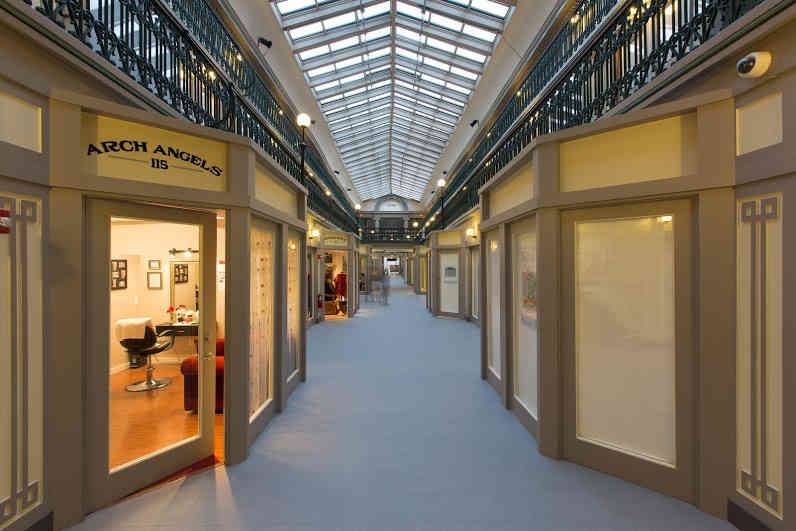



PROVIDENCE, RI — In the heart of downtown Providence, a towering Greek Revival facade that once stood as the pinnacle of 19th-century consumerism is now serving a much more vital 21st-century purpose. The Westminster Arcade, recognized as the oldest indoor shopping mall in the United States, has completed its total transformation from a struggling retail center into a thriving community of affordable micro-lofts, providing a revolutionary blueprint for addressing the nation’s housing crisis.
Built in 1828, the Arcade has survived nearly two centuries of economic shifts, but the rise of e-commerce and the decline of traditional retail threatened to leave the historic landmark vacant. Today, however, the halls that once echoed with the footsteps of Victorian-era shoppers are filled with the energy of young professionals, students, and service workers who have found a rare prize in the modern real estate market: a high-quality, dignified home for just $550 a month.
The project, spearheaded by visionary developers and local preservationists, is a masterclass in “adaptive reuse.” Rather than tearing down the granite columns and glass-paned gables to make way for a modern high-rise, the design team chose to work within the building’s historic footprint. The result is 48 micro-lofts ranging from 225 to 450 square feet. Each unit is expertly designed with built-in furniture, full bathrooms, and compact kitchens, proving that “small living” does not have to mean “lesser living.”
“This isn’t just about putting a roof over someone’s head,” said the project’s lead architect. “It’s about preserving our architectural heritage while solving the most pressing social issue of our time. We are proving that historic buildings can be part of the future, not just relics of the past.”
The transformation has been hailed as a win-win for the city. By focusing on affordability, the development has brought a diverse population back to the downtown core, stimulating the local economy. The ground floor of the Arcade remains open to the public, featuring a curated selection of local boutiques, bookstores, and small coffee shops. This “live-work” model ensures that the building remains a vibrant community hub rather than a gated residential complex.
Residents like Marcus Thorne, a local graphic designer who moved in last month, say the change has been life-altering. “Finding an apartment for under $1,200 in this city was becoming impossible,” Thorne said. “Living here, I’m right in the middle of everything. I don’t need a car, my utilities are manageable, and I’m living inside a piece of history. It feels like the city actually wants people like me to stay here.”
The success in Providence is already catching the attention of urban planners across the country. As traditional malls in suburban and urban areas face record vacancy rates, the “Arcade Model” offers a path forward. By converting these existing structures into residential spaces, cities can reduce the environmental impact of new construction, preserve local history, and rapidly increase the supply of housing.
Legislators are also taking note. The project was made possible through a combination of historic tax credits and zoning variances that allowed for smaller-than-average unit sizes. State officials are now looking to streamline these processes to encourage more developers to take on similar “adaptive reuse” challenges.
As Providence celebrates this milestone, the Arcade stands as a beacon of hope. It is a reminder that with a bit of creativity and a commitment to the common good, the relics of our past can be repurposed to build a more inclusive and sustainable future for all Americans.