





By Fabiano Maisonnave and David Biller
Associated Press
BELEM, Brazil (AP) — Brazil’s Amazon Summit closed Wednesday with a roadmap to protect tropical rainforests that was welcomed as an important step in countering climate change, but without the concrete commitments sought by some environmentalists to end deforestation.
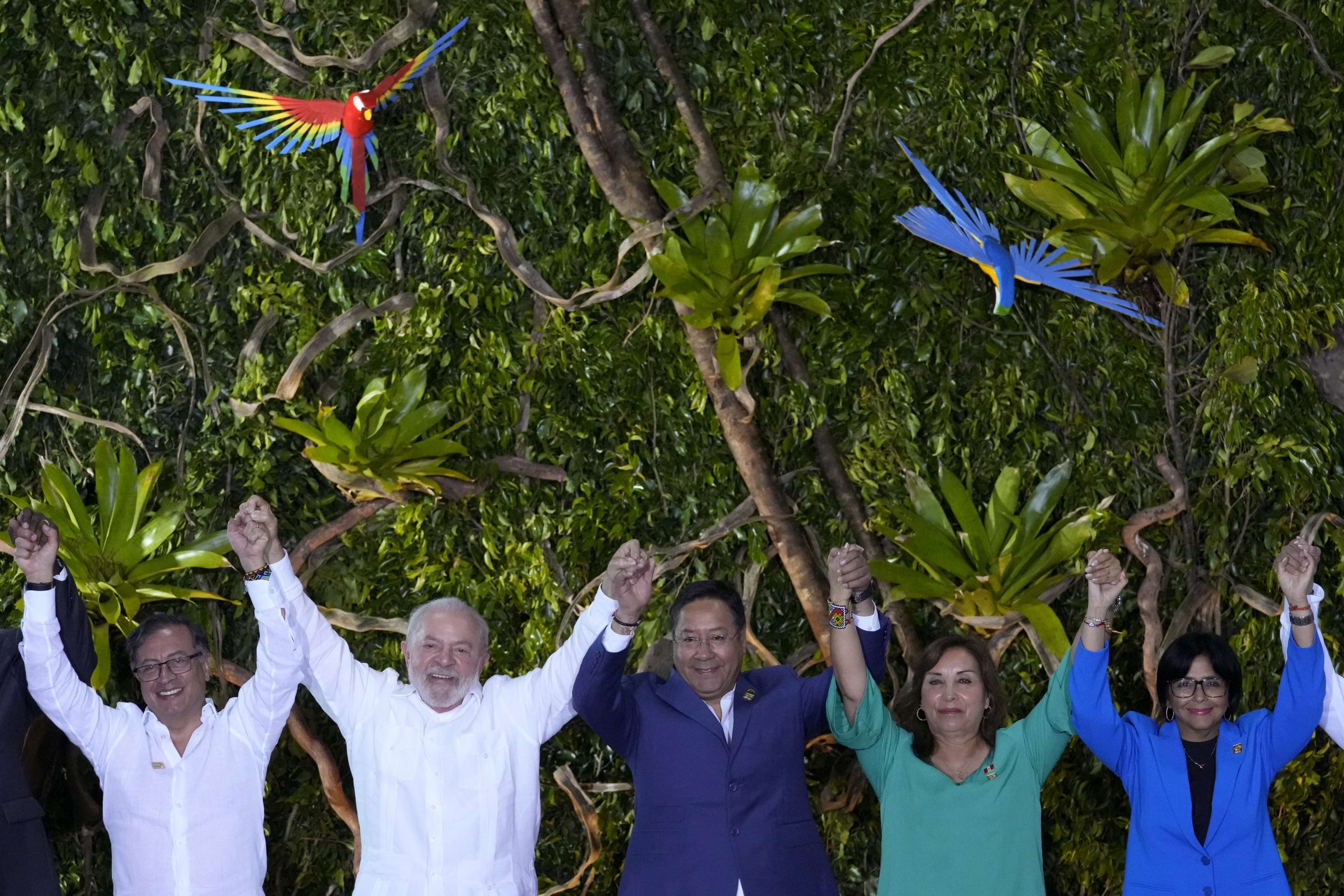
Leaders and ministers from eight Amazon nations signed a declaration Tuesday in Belem, Brazil, that laid out plans to drive economic development in their countries while preventing the Amazon’s ongoing demise “from reaching a point of no return.”
Several environmental groups described the declaration as a compilation of good intentions with little in the way of measurable goals and timeframes. However, it was lauded by others, and the Amazon’s umbrella organization of Indigenous groups celebrated the inclusion of two of its main demands.
Joining the summit Wednesday were the presidents of the Republic of Congo and the Democratic Republic of Congo, an emissary from Indonesia’s president, and France’s ambassador to Brazil, representing the Amazonian territory of French Guiana. An emissary of Norway, the largest contributor to Brazil’s Amazon Fund for sustainable development, also attended.
The national representatives on Wednesday signed a similar, but much slimmer, agreement to that of their counterparts the prior day; it likewise contained no concrete goals and mostly reinforced criticism of developed nations for failure to provide promised vast climate financing. The presidents of Bolivia, Colombia and Peru did not attend Wednesday’s meeting.
The eight nations attending on Tuesday — Bolivia, Brazil, Colombia, Ecuador, Guyana, Peru, Suriname and Venezuela — are members of the newly revived Amazon Cooperation Treaty Organization, or ACTO, who hope that a united front will give them a major voice in global environment talks ahead of the COP 28 climate conference in November.
The summit reinforces Brazilian President Luiz Inácio Lula da Silva’s strategy to leverage global concern for the Amazon’s preservation. Emboldened by a 42% drop in deforestation during his first seven months in office, he has sought international financial support for forest protection.
Speaking to reporters after Wednesday’s meeting, Lula railed against “protectionist measures poorly disguised as environmental concern” that restrict imports from developing nations, and said developed nations must make good on their pledges to provide monetary support for forest protection.
The Amazon stretches across an area twice the size of India. Two-thirds of it lies in Brazil, with seven other countries and the territory of French Guiana sharing the remaining third. Governments have historically viewed it as an area to be colonized and exploited, with little regard for sustainability or the rights of its Indigenous peoples.
All the Amazon countries have ratified the Paris climate accord, which requires signatories to set targets for reducing greenhouse gas emissions. But cross-border cooperation has historically been scant, undermined by low trust, ideological differences and the lack of government presence.
The members of ACTO — convening for only the fourth time in the organization’s 45-year existence — demonstrated Tuesday they aren’t fully aligned on key issues.
Forest protection commitments have been uneven. And their joint declaration didn’t include a shared commitment to zero deforestation by 2030, as some had hoped. Brazil and Colombia have already made that commitment.